

In 1801, Elizabeth Billington was among the most celebrated sopranos in Europe. Covent Garden and Drury Lane competed for her, and she sang in both. That season she earned about ten thousand pounds, a fortune at the time. It was also a ceiling. Alfred Marshall, writing decades later, explained why. No matter how great her voice, it could not travel beyond the walls of a concert hall. Even the best singer in the world could reach only a few thousand listeners a night.
Today the best-known singers perform for tens of millions of people at once and can earn hundreds of times what Mrs. Billington earned, adjusted for inflation. Their voices are not better than hers. Their reach is.
Sherwin Rosen’s 1981 paper, The Economics of Superstars, explains what happened. It asks why, in some markets, a small number of people earn enormous amounts of money and dominate their fields. The answer requires two ingredients and can be illustrated with a single table. It applies to singers, athletes, novelists, actors, and surgeons. And it predicts that as the world becomes richer and more connected, rewards at the very top will grow even if talent does not change at all.

This is the fifth piece in a series in which we read one classic paper at a time with AI at our side. It accompanies the book I wrote with Raul A. Sosa, AI at Your Side: The Student’s Guide to Smarter Learning, forthcoming from Oxford University Press. Each time an AI answers below, write your own answer first and then compare the two. We begin with a market of ten singers.
Two determinants
Suppose one million people are willing to pay $10 a year to hear singing, and there are ten singers ranked by talent. The first ingredient in Rosen’s argument concerns preferences: listeners want to hear the best singer available, not several lesser ones. Talent is not additive. As Rosen put it, “hearing a succession of mediocre singers does not add up to a single outstanding performance.” Economists call this imperfect substitution: several lesser talents cannot replace a greater one. The argument extends well beyond music. Rosen gives the example of a surgeon who is 10 percent better than his colleagues at saving lives. Patients may gladly pay much more than 10 percent extra for that difference. When quality matters more than quantity, buyers do not average across sellers. They choose the best.
Think first: Before reading the next paragraph, write one sentence on why this first ingredient makes the best singer earn more but cannot, by itself, make her a superstar. Then paste your sentence into an AI and ask what it gets right, what it gets wrong, and what it leaves out. Compare its correction with the paragraph that follows.
By itself, this first ingredient tells us only that the best will earn more. The concentration comes from the second ingredient: technology determines how many buyers a single seller can serve. A singer makes roughly the same effort whether ten people are listening or a thousand. The performance is produced once, and any number of listeners can enjoy it without requiring another performance. What changes is how many people the available technology allows the singer to reach. The table below compares two very different eras.
In the concert-hall era, reach has a hard limit. A hall holds only a few thousand people, and a singer can fill it only so many nights a year. Even the most successful singer might therefore reach no more than 200,000 listeners annually. If one million people want to hear a singer, the best one sells out first. The remaining listeners go to the second best, then the third, and so on, until the fifth singer serves the rest. In the streaming era, that limit disappears. A single recording can reach the entire market at almost no additional cost. Nobody has to settle for the fourth-best singer when the best is available to everyone. The others are left with the small share of listeners—say, 5 percent—who prefer a personal favorite.
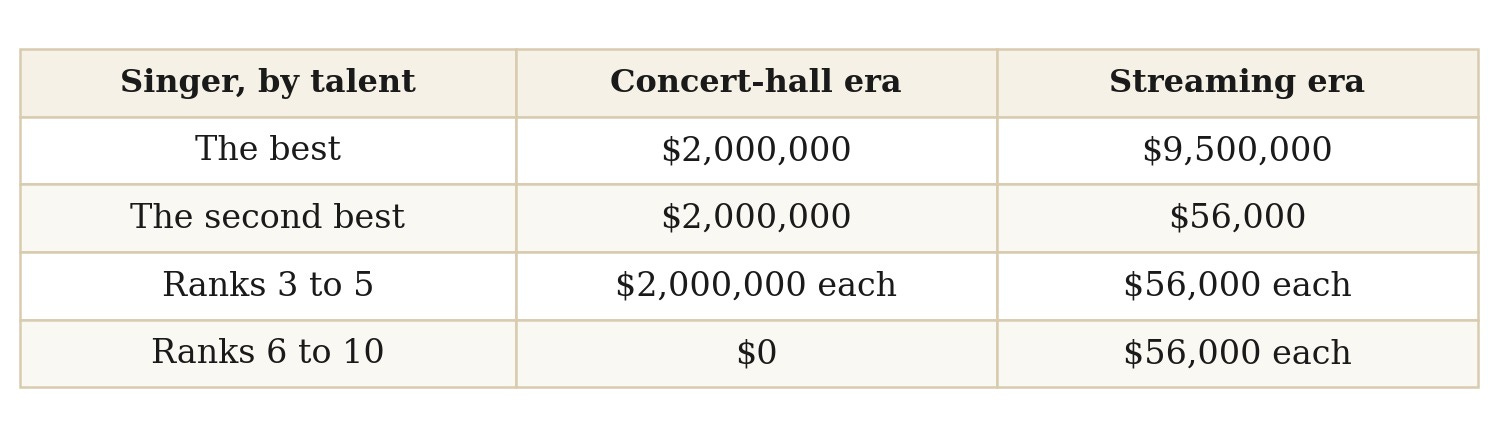
Table 1. One million listeners spend $10 each. Everyone chooses the best singer available, except that in the streaming era 5 percent remain loyal to a personal favorite and are divided evenly among singers 2 through 10. In the concert-hall era, each singer can reach at most 200,000 listeners a year. In the streaming era, reach is unlimited.
The table does the rest. In the concert-hall era, the top five singers each earn $2,000,000 because reach, not talent, is the binding constraint. This is Mrs. Billington’s world: being the best was worth no more than being fifth. In the streaming era, that constraint disappears. The best singer reaches everyone who wants the best and earns $9,500,000, while each of the others receives about $56,000 from personal fans. Their relative talents did not change. Only the technology did, creating a gap of more than nine million dollars where none had existed before.
This is the exercise to hand an AI, because the numbers are yours to change.
Prompt: “A market has 1,000,000 listeners who each pay $10 a year, and ten singers ranked by talent. Everyone buys from the best singer available. Era 1: any singer can reach at most 200,000 listeners a year. Era 2: reach is unlimited, but 5 percent of listeners stick with a personal favorite, spread evenly over singers 2 to 10. Compute each singer’s earnings in both eras. Then double the number of listeners in Era 2 and recompute. What changed for the best singer, and what changed for the rest?”
The response (generated using Claude):
Era 1: the first five singers each serve 200,000 listeners and earn $2,000,000. Listeners run out before singers 6 to 10 get any. Era 2: the best singer serves the 950,000 listeners who want the best, earning $9,500,000. The other 50,000 listeners split evenly among singers 2 to 10, about 5,556 each, so each earns about $56,000. Doubling the market doubles everyone: the best singer goes to $19,000,000, the others to about $111,000. The gap between first and second was zero dollars in Era 1. In Era 2 it is $9.4 million, and after the market doubles it is $18.9 million. Nobody sang better. The market got bigger, and all of the growth at the top went to the same person.
That last line summarizes Rosen’s result. Small differences in talent can produce enormous differences in reward, and the larger the market, the more extreme the result. Our table holds the price fixed at $10, so greater talent is rewarded only through a larger audience. In Rosen’s fuller model, the star also charges more than her rivals. Talent therefore affects both price and quantity. In one of his examples, a performer twice as talented as another earns four times as much.
Check: Recompute at least one of the response’s figures by hand before accepting it. Then change one assumption: raise the loyal share from 5 percent to 20 percent and, before asking again, predict two things: what share of the new money doubling the market now sends to the star, and whether the second-best singer is now better off than she was in the concert-hall era. Where your prediction and the AI’s answer disagree, work out which of you is wrong and why.
The reach machines
Rosen closed the paper by returning to Marshall’s soprano. The limit on Mrs. Billington’s income was not demand but the reach of the human voice. “Imagine her income,” Rosen writes, “had radio and phonograph records existed in 1801!” Every new technology of reproduction—the phonograph, radio, film, television, and now streaming—has extended that reach by allowing the same performance to be enjoyed by a larger audience. Television, in Rosen’s words, “clones” a performance for everyone who tunes in.
As each new technology extended reach, markets moved closer to the second column of the table, and the data broadly followed Rosen’s prediction. Alan Krueger, who spent years studying the music industry, found that the share of concert revenue earned by the top 1 percent of performers rose from 26 percent in 1982 to 56 percent in 2003 and to about 60 percent by 2017. By then, the top 5 percent were taking home almost 90 percent. Streaming is even more concentrated. An analysis of streaming data from 2019–2020 by the analytics firm Alpha Data found that the top 16,000 artists—the top 1 percent of the 1.6 million artists included in the data—accounted for 90 percent of all streams. As the world grew richer and more connected, more money entered these markets and a growing share went to the top.
Notice what the mechanism does not require. No one has to conspire or cheat. Listeners simply choose the best performer available, and technology allows all of them to choose the same person at once. The inequality at the top of these markets is what individual choice produces when reach is unlimited.
The movies
Film shows the same logic, with a twist I discussed in What Happened to the Movies? Under the old studio system, and for decades afterward, the industry supported a broad middle: mid-budget films, working actors, and directors who could sustain long careers without becoming stars. Streaming and global distribution gradually changed that market. As successful films could reach audiences around the world at very little additional cost per viewer, studios increasingly concentrated on the products that traveled farthest. Franchises, familiar characters, and pre-sold stories came to dominate the business. The middle thinned out, leaving giant global productions at one end and small niche films at the other.
Rewards for stars became more concentrated along with the films themselves. A handful of performers attached to global franchises earn enormous sums, while the working actors below them face the winner-take-most market that Rosen’s model predicts: a small group at the top captures most of the rewards. Much the same happened in music, as I discussed in my piece on Krueger’s Rockonomics. Technology expanded access while concentrating income within the industry. There is more content than ever, but fewer durable careers.
Transfer: Choose a market this essay has not worked through: textbooks, surgeons, football players, lawyers, or professors. Decide for yourself whether quality is imperfectly substitutable there and what limits reach. Then ask an AI the same two questions and whether the market should be winner-take-most. Check its mechanism, and yours, against the pay you can observe. If it predicts a superstar market, ask it for one fact that would prove the prediction wrong.
The age of AI
AI changes superstar markets through two distinct channels. It extends the reach of those already at the top, while also making entry much easier and multiplying the number of competitors.
AI is the next technology of reach. Translation and dubbing allow the same performer to enter markets that were previously separated by language, while recommendation systems can direct enormous audiences toward the same names. In Rosen’s model, this expands the market available to the star and increases the rewards at the top. If the world also grows richer and spends more on entertainment, those rewards grow further.
At the same time, AI floods the market with new products. When almost anyone can produce a song, a video, or a book at very little cost, the number of sellers explodes. This is where Rosen’s first ingredient does the sorting. Listeners can choose among millions of products, but they still want the ones they consider best. Production becomes abundant; attention and trust become scarce. A million AI-generated songs are not a substitute for the one performance listeners consider outstanding. AI is therefore unlikely to eliminate superstars. It may instead produce an even more extreme superstar market: entry becomes easier, the number of contestants grows, and so does the reward for reaching the top. This is close to the dynamic Glenn MacDonald described in his model of rising stars, in which large numbers of young performers accept low earnings in exchange for a small chance of becoming stars.
The conclusion above is the kind of claim to make an AI argue against.
Counter-thesis: Ask an AI to defend the opposite claim, that generative AI will weaken superstar markets rather than strengthen them, in music, in books, and in university teaching. Require the argument to run through both ingredients, substitutability and reach, and to say which one it is attacking. Before reading the response, write down which effect you expect to dominate in each. The useful comparison is across the three markets, because the assumptions that differ between them are the ones doing the work.
The response (generated using Claude):
The case for weakening attacks the first ingredient. If AI can produce a song tailored to each listener, “the best available” stops being one person and becomes a different product for every buyer, so listeners stop agreeing on who the best is. The weakening mechanism does not operate primarily through reach: the star may still reach everyone, but fewer listeners want the same thing. Music is where this bites hardest, because tastes are already fragmented and the cost of a custom song is falling fastest. Books resist longer, since part of a novel’s value is that other people have read it. University teaching is the hardest case for the counter-thesis: students want the credential and the reputation, which are scarce by construction, so the star professor’s reach grows and substitution does not.
The response concedes that its mechanism does not run through reach, so the counter-thesis stands or falls on the first ingredient: whether listeners stop agreeing on who is best. It also leaves something out. If one platform produces personalized songs for everyone, concentration may move from performers to the platform rather than disappear. Whether tastes fragment enough to break the ranking is an empirical question, and the three markets give three different answers.
Concentrated voice
The same two ingredients have another consequence. Technologies of reach concentrate not only income but also attention, and attention brings influence. A superstar can reach vastly more people than most experts, and there is evidence that this reach changes behavior. Craig Garthwaite and Timothy Moore (2013) estimate that Oprah Winfrey’s endorsement generated roughly one million additional votes for Barack Obama in the 2008 Democratic primary. Hoffman and Tan (2013) show why people may treat celebrity status as a signal of credibility, even when the celebrity has no expertise in the matter at hand.
It should therefore not surprise us that superstars use their reach to intervene in public debates, from health to geopolitics. Some do so out of conviction. In other cases, what economists call image motivation may also play a role: taking a public position can produce a reputational return, and that return increases with the size of the audience (Bénabou and Tirole, 2006). For a superstar, that audience is enormous by construction. But the economic point is simple. The market that created the star rewarded one talent—singing, acting, or playing a sport. It tested nothing else. Fame acquired in one market does not create expertise in another. And the technology that makes the star’s opinion loud is the same technology that made the star rich.
The worst way to read Rosen today is to ask an AI to explain the superstar phenomenon. You will get the phrase “winner-take-all” and move on, none the wiser about why. The better approach is the one we have followed here: build a small market, predict what a change in reach will do, and let an AI recompute the results. The arithmetic does the rest. AI can help, but only as a sparring partner. That is the discipline this series is trying to build.
Exercises
Reconstruction (no AI). State Rosen’s two ingredients in your own words, and explain why each alone is not enough. What would the market look like with imperfect substitution but capped reach? What would it look like with unlimited reach but perfect substitution, where two mediocre singers really do add up to one great one?
The table by hand (no AI). Using Table 1’s assumptions, find the smallest hall capacity at which the best singer can serve the whole market by herself, leaving the second best with nothing. Then explain in one sentence why small halls protect the second best.
Break it (AI, then check it). Ask an AI what still protects second-best sellers in the streaming era: language, geography, personal taste, live performance, loyalty. Then have it remove each protection one at a time and predict what happens to the earnings distribution. Which protection does AI itself erode fastest?
The microphone (AI, both sides). Ask an AI to argue that superstar influence on public debate is harmless, then to argue that it is costly. Use Rosen to referee: which side is making a claim about talent, and which about reach?
The price channel (AI). Table 1 holds the price at $10, so talent is rewarded only through audience size. Ask an AI to let the best singer charge a premium and to show that when both price and audience rise in proportion to talent, a singer twice as talented earns four times as much, Rosen's own example. Then ask which assumption about listeners the premium requires, and check it against the first ingredient.
References
Roland Bénabou and Jean Tirole (2006). “Incentives and Prosocial Behavior.” American Economic Review 96(5): 1652–1678.
Emily Blake (2020). “Data Shows 90 Percent of Streams Go to the Top 1 Percent of Artists.” Rolling Stone, September 9, 2020. Based on data from Alpha Data.
Craig Garthwaite and Timothy J. Moore (2013). “Can Celebrity Endorsements Affect Political Outcomes? Evidence from the 2008 US Democratic Presidential Primary.” Journal of Law, Economics, and Organization 29(2): 355–384.
Steven J. Hoffman and Charlie Tan (2013). “Following Celebrities’ Medical Advice: Meta-Narrative Analysis.” BMJ 347: f7151.
Alan B. Krueger (2005). “The Economics of Real Superstars: The Market for Rock Concerts in the Material World.” Journal of Labor Economics 23(1): 1–30.
Alan B. Krueger (2019). Rockonomics: A Backstage Tour of What the Music Industry Can Teach Us About Economics and Life. Currency.
Glenn M. MacDonald (1988). “The Economics of Rising Stars.” American Economic Review 78(1): 155–166.
Alfred Marshall (1920). Principles of Economics, 8th edition. Macmillan.
Sherwin Rosen (1981). “The Economics of Superstars.” American Economic Review 71(5): 845–858.
Sebastian Galiani and Raul A. Sosa (forthcoming). AI at Your Side: The Student’s Guide to Smarter Learning. Oxford University Press.
If this essay resonated with you, you can subscribe to my Substack for regular reflections on economics, politics, geopolitics, AI, and literature.
Disclaimer: I use ChatGPT as an editorial tool to help me refine the structure and writing of these essays. The ideas, arguments, and judgments are my own, and I take full responsibility for them.