

What happens when AI can finally read all our books?
“The Library is total…” — Jorge Luis Borges
Most of humanity’s greatest ideas are trapped in books no algorithm has ever read. Imagine the day machines finally do. That moment would not just be technical—it could rival the printing press in reshaping knowledge itself.
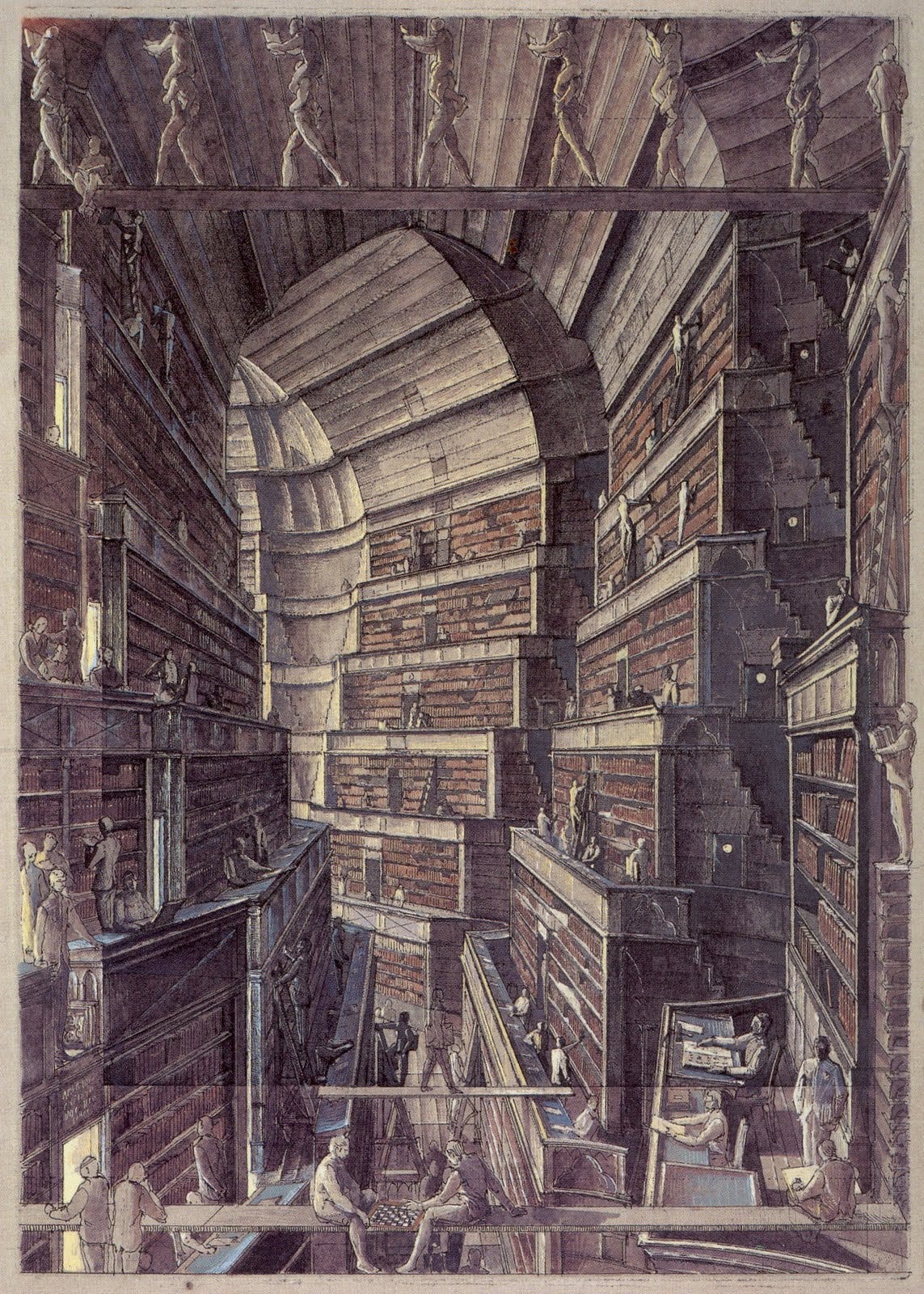
Imagine a world where artificial intelligence has access not just to the internet, but to the entire corpus of human books. Fiction, nonfiction, science, literature, history, philosophy, economics—all of it. Not just bestsellers or public domain classics, but the full spectrum of what humanity has written and preserved.
This is not a fantasy. It is entirely within reach. And if we make it happen, it could become the single biggest leap in knowledge creation since the invention of the printing press.
From Threads to Volumes
AI today learns mostly from what’s online—Reddit threads, Wikipedia entries, scraped websites. That’s taken us far. But books are different.
Books contain depth, context, structure, and memory. They develop ideas slowly. They preserve forgotten insights. Many of our greatest contributions—across every field—live in paragraphs that have never gone viral.
If AI could train on the full richness of books, we could:
Synthesize theories across disciplines in real time
Revisit long-buried insights and bring them back to light
Ask new questions—not just find old answers
Turn centuries of thought into seconds of reasoning
Imagine a GPT trained not just on StackOverflow, but also on the works of Darwin, Arendt, Borges, Popper, Maimonides, Kissinger, and Sen. Imagine it connecting those dots in ways no scholar could alone.
Equality of Access
This shift wouldn’t benefit only the research frontier. Just as importantly, it would put high-quality knowledge into the hands of anyone, anywhere.
A farmer in Ghana. A student in rural India. A 14-year-old girl in Afghanistan with a smartphone. Each could have a Socratic tutor—trained not on clickbait or summaries, but on full texts, explained and translated.
This is equality of opportunity at a scale we’ve never seen.
The Real Development Engine
At its core, development is about the diffusion of ideas. When people can access better ideas, they adapt them. Innovation happens. Societies grow.
If we want to reduce global inequality, this is one of the most powerful tools we have—not just infrastructure or funding, but unlocked minds.
But Isn’t It Expensive?
Yes, many books are still under copyright. Royalties must be paid. Use must be regulated. But:
Millions of books are already in the public domain
Thousands more are shared by academics and open-access publishers
Countless authors would gladly consent, if asked
We don’t need everything to start. We just need enough. And it wouldn’t require vast sums—especially relative to its impact.
The printing press didn’t wait for permission. It began with what it had—and changed the world.
Not a Fantasy, but a Choice
This isn’t a technical challenge. It’s a question of vision.
We already have the models. We already have the infrastructure. What’s missing is the decision to let artificial intelligence learn from the best of human intelligence—what we’ve written in our books.
Borges imagined a library so vast it was chaos. We have the tools to build one that is ordered, searchable, and shared. The question is no longer whether AI can learn from our books. It is whether we have the vision to let it—and to open that knowledge to every mind, everywhere.
*** Disclaimer: I used ChatGPT-4.0. as an editorial and language-refinement tool. The ideas and arguments are entirely my own, and I take full responsibility for them.
.