

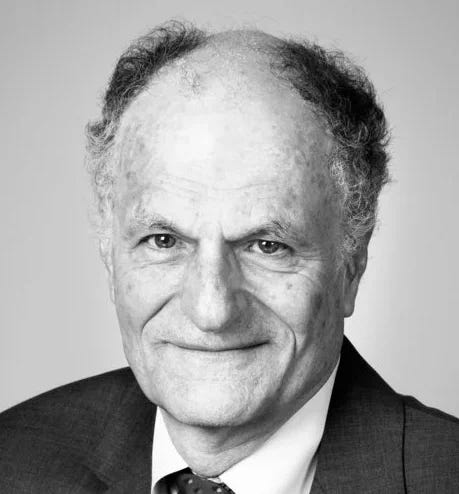
In this essay, I discuss a remarkable paper by Thomas Sargent, the Nobel Prize-winning economist whose work reshaped modern macroeconomics, on the intellectual origins of artificial intelligence. What makes the paper so interesting is that Sargent does not approach AI primarily as an engineering achievement or a set of recent computational breakthroughs. He approaches it instead as part of a much longer intellectual history. His central claim is that AI is not something alien to human intelligence. It is, rather, an extension of a deeply human project: the effort to compensate for the limits of our own minds through disciplined reasoning, formalization, and science.
Sargent’s argument can be read as a sequence of simple but powerful claims.
First, human beings are cognitively limited in domains that matter enormously in modern life. Here Sargent draws on the work of Steven Pinker, who has long emphasized that our intuitions are poorly suited for reasoning in areas such as probability, statistics, markets, and evolutionary processes. We are not natural Bayesians. We misread randomness. We struggle with nonlinear systems. These are not peripheral weaknesses. They sit at the core of economics, science, and policy. Education, then, becomes more than the transmission of knowledge. It becomes a way of correcting the mind’s natural blind spots.
Second, AI emerges as a human-made response to those limits. Not as a replacement for human intelligence, but as its extension. If our minds are not built to process high-dimensional data, to update beliefs consistently under uncertainty, or to solve complex optimization problems, we construct tools that can. In that sense, AI is continuous with earlier intellectual technologies: the calculator, the statistical model, the ledger, the algorithm. It is what happens when disciplined reasoning is pushed further, and partially automated.
Third, what we now call machine learning has deep roots in the history of science. Sargent’s historical move here is particularly elegant. He invites us to see figures like Galileo Galilei and Charles Darwin as early practitioners of something like machine learning. Galileo generates data through experiment, identifies patterns, fits simple laws, and generalizes beyond the sample. Darwin collects a vast array of observations, compresses them into a small set of principles, and uses those principles to explain and predict. The underlying logic—data, compression, generalization—is already present. What changes over time is scale, formalization, and computational power.
Fourth, modern AI is not a standalone invention. It is a synthesis. Physics contributes optimization, dynamics, and ideas such as entropy. Biology contributes evolution, adaptation, and selection. Statistics provides inference, uncertainty, and model fitting. And economics—perhaps the least obvious to non-economists—contributes decision theory, equilibrium reasoning, incentives, decentralized coordination, and learning in strategic environments. Sargent is particularly sharp on this point: many of the mechanisms that make AI systems work—updating rules, reinforcement, competition among rules, even internal “markets” for attention or resources—have clear analogues in economic theory.
Fifth, and perhaps most importantly, innovation does not come from starting from scratch. It comes from mastering what already exists and then extending it. This is true in science, and it is true in AI. Isaac Newton did not begin from zero. Nor did Albert Einstein. They absorbed, recombined, and then transcended. The same pattern holds for AI. The frontier is not created ex nihilo. It is built by recombining tools that were developed, often decades or centuries ago, in different fields.
Seen this way, Sargent’s essay is doing something more subtle than explaining AI. It is situating it. It places AI inside a long intellectual trajectory in which human beings confront the limits of their own cognition and respond by constructing formal systems that extend it.
My overall reading, then, is that this is not really a technical paper about current AI systems. It is a wide-ranging intellectual essay about where AI comes from, why it was possible, and why the sciences and economics matter so much in understanding it. And, quietly, it is also a defense of education. Not education as signaling, or credentialing, but as discipline: as the acquisition of ways of thinking that correct for the biases of common sense.
What Sargent does not fully develop, however, is a further step that now seems unavoidable. If AI is an extension of human reasoning, then we also need to educate people in how to use it well. The central question is no longer only how AI works, but how humans should think with it. The risk is not simply that machines replace us. The deeper risk is that we fail to learn how to use them to augment our intelligence.
This is, fundamentally, an educational problem. Just as we had to learn statistics to correct our intuitions about randomness, or economics to understand incentives, we now need to learn how to interact with AI systems so that they extend our reasoning rather than substitute for it. Used well, AI can sharpen thought, accelerate understanding, and expand analytical capacity. Used poorly, it can flatten thinking and create the illusion of understanding.
This is precisely the motivation behind my forthcoming book with Raúl A. Sosa, AI at Your Side: The Student’s Guide to Smarter Learning (Oxford University Press). The objective is not to teach how to delegate thinking to AI, but how to use AI as a partner in thinking—to build structures of interaction that allow the technology to amplify, rather than erode, human intelligence.
The deeper message, I think, is this: the subjects that feel hardest—statistics, economics, biology, physics—are precisely the ones that matter most. Not only because they help us understand the world, but because they are the very foundations on which artificial intelligence has been built.
And now, they are also the foundation for learning how to live with it.
References
Sargent, Thomas. On AI and its intellectual foundations, 2023.
Pinker, Steven. How the Mind Works and related writings on human cognition and its limits.
***If this essay resonated with you, you can subscribe to my Substack for regular reflections on economics, politics, geopolitics, AI, and literature.
*** Disclaimer: I used ChatGPT-5.4. as an editorial and language-refinement tool. The ideas and arguments are entirely my own, and I take full responsibility for them.
Muy interesante artículo Sebastián. Suscribo prácticamente todo lo que apuntas!
Very interesting article; however a brief introduction of Tom Sargent would have been helpful for those of us who are noneconomists. Grateful always to Wikipedia for an introduction.