

Recently, I read chapter 3 of Viviana Ackerman’s excellent book El Divino Desorden: Claves para Leer a Borges. The chapter introduces a useful framework for reading Borges, one drawn from modern narratology. It begins with a deceptively simple question:
Who writes Borges?
At first glance, the answer seems obvious: Borges writes Borges.
Yet literary theory has long argued that things are not so simple.
One of the central contributions of narratology is to distinguish between figures that readers often collapse into one. We tend to assume that the person whose name appears on the cover is the same person speaking inside the text. But this is rarely true.
The first distinction is between the empirical author and the author.
The empirical Borges is the historical individual: the man born in Buenos Aires in 1899, the lecturer, the traveler, the reader of Anglo-Saxon poetry, the public intellectual who died in Geneva in 1986.
But once we open a book, that Borges disappears.
The Borges who constructs stories is not identical to the historical person. Literature is not testimony. A literary work cannot be reduced to the virtues, flaws, opinions, or experiences of the individual who produced it. The author creates an artifact whose meaning exceeds biography.
A second distinction is between the author and the narrator.
The narrator is the voice that speaks within the text. Sometimes the narrator resembles the author. Sometimes he does not. Sometimes he even bears the author’s name. Yet from a literary perspective, the narrator remains a construction of the text.
This is where Borges becomes particularly interesting.
In stories such as The Aleph, the narrator is called “Borges.” Many readers therefore conclude that Borges is simply recounting events from his own life. But literary theory asks us to resist that temptation. The narrator called Borges is still a literary figure, a character created by the author.
The situation becomes even more complex because Borges frequently introduces additional narrative layers. Characters tell stories. Other characters quote them. Manuscripts appear inside stories. Narrators become characters and characters become narrators. Borges builds labyrinths not only of time and space, but also of voice.
The same complexity appears on the receiving end.
Who is being addressed?
There is the actual reader. But there may also be an implied reader, an imagined interlocutor, or even characters within the text who function as recipients of particular statements. Literary communication operates simultaneously on several levels.
So far, the theory seems straightforward.
Then we encounter Borges y yo.
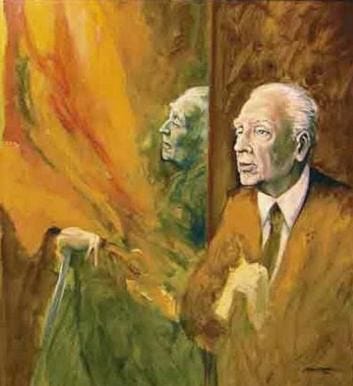
Ackerman argues that the text creates difficulties for these distinctions. At first sight, it certainly does.
The opening sentence introduces two figures: the public Borges and the private “I.” One is the celebrated writer whose name appears in encyclopedias. The other is the intimate self who walks through Buenos Aires and experiences life.
The distinction appears clear.
Yet as the text unfolds, the boundaries begin to blur.
Who is speaking?
Who is being spoken about?
Who writes the final sentence?
At first, I accepted this reading. But after rereading the text, I have come to a different conclusion.
Far from being a challenge to narratology, Borges y yo seems to me one of its most elegant demonstrations.
Ackerman follows the standard theoretical position: strictly speaking, the empirical Borges can never enter the text. The moment the empirical Borges appears on the page, he becomes a literary construction, a character created by the author.
I understand the argument. Yet I am not entirely persuaded.
Why should the empirical Borges be excluded in principle from becoming a character in a text written by Borges himself?
After all, Borges was not merely a private individual. He was also a public figure, a cultural icon, someone whose public existence could itself become literary material. Shakespeare appears in literature. Napoleon appears in literature. Cervantes appears in literature.
The distinction remains useful, but perhaps it should not be treated as absolute.
What Borges y yo does is not collapse the distinction between author, narrator, and character. Rather, it places pressure on the boundary separating them.
Borges the author creates a narrator who presents himself as Borges the private self and reflects upon another figure: Borges the public writer.
In other words, Borges the author constructs a narrator who tells a story about the relationship between Borges the private man and Borges the literary figure.
Far from dissolving the distinctions proposed by narratology, the text depends on them.
The famous final sentence does not abolish the categories. It activates them.
The question is not psychological.
It is structural.
Who writes this page?
The narrator?
The public Borges?
The author who created them both?
The brilliance of the text lies precisely in making all three answers seem plausible at once.
For that reason, I increasingly think that Borges y yo is not a refutation of narratology. It is one of its finest literary demonstrations.
Borges does not destroy the distinction between author, narrator, and character.
He turns that distinction into literature.
And perhaps that is one reason why Borges continues to generate new interpretations forty years after his death. He does not merely invite interpretation.
He makes interpretation itself one of his subjects.
***If this essay resonated with you, you can subscribe to my Substack for regular reflections on economics, politics, geopolitics, AI, and literature.
*** Disclaimer: I used ChatGPT-5.2. as an editorial and language-refinement tool. The ideas and arguments are entirely my own, and I take full responsibility for them.
Muy bueno, Sebas!